
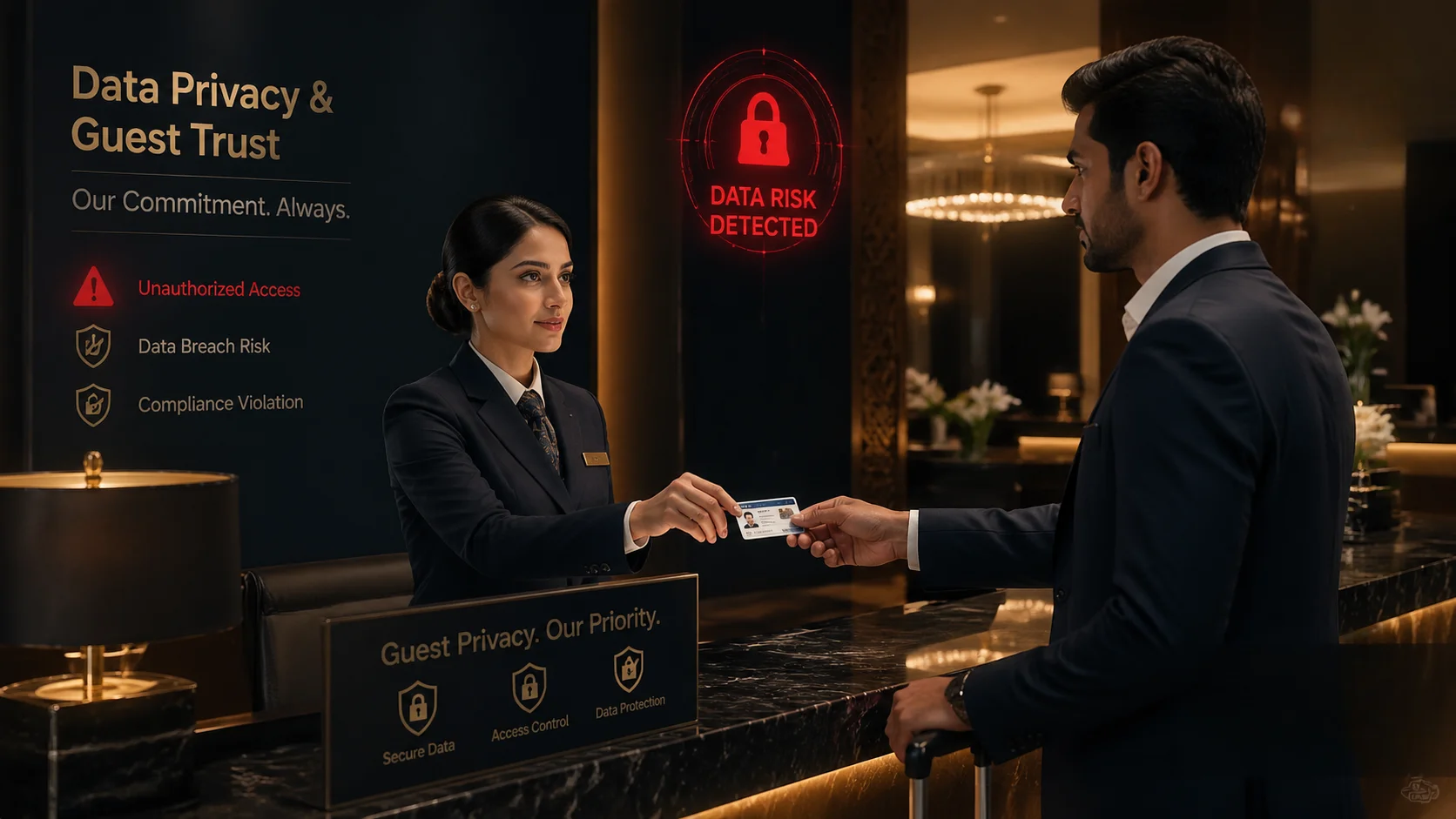
For decades, hotel front desks have followed a simple playbook:
- Ask for ID
- Take a photocopy or scan
- Store it somewhere
- Move on to the next guest
It worked because there were no real consequences tied to how that data was handled.
That era is over.
Today, every time a receptionist asks for a guest’s ID, they are effectively initiating a regulated data transaction. That transaction comes with obligations, accountability, and potential penalties.
And the uncomfortable truth is this:
Most hotel front desks in India are not designed to handle this responsibility.
What Changed: From Service Interaction to Data Processing Event
At a surface level, check-in still looks the same.
A guest arrives. They hand over identification. Details are recorded.
But legally, this interaction has transformed into something much more complex:
The hotel becomes a Data Fiduciary
The guest becomes a Data Principal
The ID becomes sensitive personal data
This means the front desk is now responsible for:
- collecting data with valid consent
- explaining why the data is needed
- storing it securely
- restricting who can access it
- deleting it when no longer required
What used to take 2 minutes now carries long-term legal consequences.
The Reality on the Ground: Where Things Break
Let’s move away from theory and look at what actually happens inside most hotels.
1. Consent Is Either Missing or Meaningless
In most properties, consent is assumed, not captured.
A guest hands over their ID, and that action is treated as implied permission.
But under DPDP, that doesn’t hold.
Consent must be:
- explicit
- informed
- purpose-specific
- revocable
Now compare that to reality:
- No explanation is given to the guest
- No written or digital acknowledgment exists
- No record of what the guest agreed to is stored
If questioned, the hotel has no defensible proof.
This is not a minor gap. It’s a foundational compliance failure.
2. Data Collection Happens in Unsafe Ways
Walk into ten hotels and you’ll likely see some combination of:
- IDs being photocopied
- Photos being taken on personal phones
- Documents sent over WhatsApp
- Scans emailed between staff
This creates a fragmented, uncontrolled data environment.
The problems here are obvious:
- No encryption
- No access control
- No audit trail
- No way to track where data actually resides
From a legal standpoint, this is high-risk behavior.
From a practical standpoint, it’s chaos.
3. Front Desk Staff Are Not Trained for Data Responsibility
Receptionists are trained for:
- guest handling
- upselling
- conflict resolution
They are not trained for:
- data protection principles
- consent handling
- breach awareness
- compliance obligations
So what happens?
They default to speed.
They prioritize reducing queue time over proper data handling.
And that creates a dangerous gap between what the law expects and what the staff actually does.
4. No Clear Purpose Limitation
Ask most hotels:
“Why are you collecting this data?”
You’ll hear vague answers like:
“for records”
“for security”
“for compliance”
But DPDP requires clear, specific purpose definition.
At the front desk level, this translates to:
- explaining why ID is needed
- limiting data collection to that purpose
Instead, hotels often collect more than necessary and store it indefinitely.
That’s not just inefficient. It’s non-compliant.
5. Data Retention Is Undefined
This is one of the most overlooked risks.
Once a guest checks out, what happens to their data?
In most cases:
- it stays in the system
- it remains in email inboxes
- it exists in backups
- it may even sit in physical files
There is no defined lifecycle.
No deletion policy. No automation.
Under DPDP, this becomes a liability.
Because holding data without purpose is not neutral. It’s a violation.
6. Access Control Is Practically Non-Existent
In many hotels:
- multiple staff members can access guest data
- credentials are shared
- systems lack role-based permissions
This means anyone at the front desk can view sensitive information; there is no accountability for misuse and internal breaches are almost impossible to trace
From a compliance perspective, this is a serious failure.
From a risk perspective, it’s an accident waiting to happen.
7. No Audit Trail
If a regulator asks:
“Who accessed this guest’s data and when?”
Most hotels cannot answer.
Because:
access logs don’t exist
systems are not integrated
manual processes leave no trace
Without an audit trail, even a compliant action becomes impossible to prove.
And in a legal context, lack of proof equals non-compliance.
8. Guest Rights Cannot Be Fulfilled
Under DPDP, guests have rights:
access their data
request correction
request deletion
withdraw consent
Now imagine a guest emails the hotel:
“Please delete all my data.”
What happens next?
In most cases:
staff scramble to locate the data
they check multiple systems
they miss copies stored elsewhere
they have no structured workflow
This turns a simple request into an operational nightmare.
And if the hotel fails to respond in time, it becomes a compliance issue.
9. Front Desk Is the Weakest Link in Breach Scenarios
When data breaches happen, they rarely start in sophisticated systems.
They start in simple places:
a misplaced document
a forwarded email
a shared login
a compromised device
The front desk is especially vulnerable because:
it handles high volumes of data
processes are fast-paced
controls are minimal
And when a breach occurs, DPDP requires:
rapid detection
timely reporting
structured response
Most hotels are not equipped for this.
The Core Problem: Systems Were Never Designed for Compliance
Here’s the deeper issue.
Hotels didn’t design their front desk systems for:
- data accountability
- auditability
- legal defensibility
They designed them for:
- speed
- convenience
- operational efficiency
That worked when regulations were light.
It doesn’t work anymore.
Now, the front desk sits at the intersection of:
- customer experience
- operational workflow
- legal compliance
And the current setup cannot support all three.
What This Means in Practice
Let’s translate all of this into a simple truth:
Every check-in creates a chain of responsibility.
If any link in that chain breaks, the hotel is exposed.
That chain includes:
- Consent capture
- Data collection
- Storage
- Access
- Retention
- Deletion
- Auditability
Right now, most hotels have weak links at multiple points.
The Hidden Cost of Ignoring This
A lot of operators still see this as a “future problem.”
It’s not.
The risks are already real:
1. Regulatory Penalties: Non-compliance can lead to financial penalties that scale with the severity of the violation.
2. Reputation Damage: Data misuse or breaches erode trust faster than almost anything else in hospitality.
3. Operational Disruption: Handling complaints, audits, or breaches consumes time and resources.
4. Loss of Customer Confidence: Guests are becoming more aware of how their data is handled.
And once trust is lost, it’s hard to regain.
Where Most Hotels Will Struggle
Let’s be honest.
The biggest challenge is not understanding the law.
It’s execution.
Hotels will struggle with:
- integrating compliance into fast-paced front desk operations
- training staff without slowing down service
- replacing legacy systems
- balancing guest experience with legal requirements
And this is where many will default to doing the bare minimum.
But minimum compliance is fragile.
It breaks under scrutiny.
The Opportunity Hidden Inside This Shift
Now flip the perspective.
This isn’t just a risk.
It’s also an opportunity.
Hotels that get this right can:
build trust with guests
differentiate on safety and professionalism
reduce operational chaos
create cleaner, more efficient data systems
Because the same systems that enable compliance also improve operations.
Final Thought
The front desk used to be judged on:
speed of check-in
friendliness
efficiency
Now it must also be judged on:
compliance
data integrity
accountability
That’s a fundamental shift.
And the hotels that recognize this early will have an advantage.
The ones that don’t will eventually be forced to react under pressure.
Either way, the direction is clear:
The front desk is no longer just where the guest journey begins.
It’s where legal responsibility begins.